St. Alphonsus Parish
Once the turmoil of the mid-1800s—the Texas Revolution, the U.S. War with Mexico, and the Civil War—subsided, San Antonio’s population grew dramatically due to the city’s links to the American and Mexican economies. These connections expanded with the arrival of the railroad in the late 1870s, more than doubling the number of its inhabitants from about 20,000 in 1880 to approximately 96,000 in 1910. Economic and political developments in Mexico, along with the flourishing of agricultural resources and the rise of major cities in the United States, propelled San Antonio’s population to about 160,000 in 1920 and 250,000 in 1940. The Cold War military installations further boosted the city’s growth, which rose to 590,000 in 1960 and skyrocketed to over a million by 2000.
In the late 1800s, as the traditional center of the city became the Anglo-American business core, most of San Antonio’s Mexican and Mexican American population lived, both by choice and due to social and economic pressure, west of San Fernando. This created the Laredito barrio along the road leading to Laredo. Railroads later sliced through the neighborhood, and Mexican Americans moved further west as city leaders surveyed what used to be the town’s common lands. There, Mexican Americans fashioned a vibrant community with tienditas (small stores), restaurants, and businesses that offered Westside residents the services they needed. Eventually, the city appropriated farmlands even beyond the original city limits, and some residents from the Westside opted to move to the new developments.
The number of Catholics rose proportionately throughout this period, and bishops and archbishops were pressed to find priests and women religious to meet the spiritual needs of the faithful. Initially, in the 1800s, they reached out to faith communities and congregations of priests and sisters elsewhere in the nation and in Europe. Later, American, Mexican, and Mexican American clergy and sisters—many of them from Texas and San Antonio itself—served the faithful.
Initially, Claretian priests began ministering to San Antonio's Mexican and Mexican American Catholics in 1902 at the San Fernando Cathedral. In response to their flock's expansion west of downtown, the Claretians opened new parishes: Immaculate Heart of Mary on South Santa Rosa Street and Our Lady of Guadalupe in 1911 on El Paso Street.
Soon after, there was a need to establish a mission beyond the immediate area of the Guadalupe parish. Around 1917, a small, hall-type church was built at 2140 Tampico Street and Murry Street. That little building had only two rows of pews, an altar, and a crucifix. The Eucharist was celebrated there once a month, but the little church was open twenty-four hours a day throughout the year, and neighbors regularly came in to pray. Mrs. Antonia Pérez assumed the role of sacristan, and her husband, Mr. José Pérez, petitioned the bishop for a bigger, permanent church sometime around 1923. Two years later, 346 children were confirmed at this outpost.
A new parish was created in 1925 with boundaries to the north between West Commerce and Frio City Road and to the west from Sabinas Street, reaching five miles beyond the city limits. This area comprised a total of twenty square miles. A new church built on Chihuahua Street was blessed on June 14, with approximately 1,400 faithful attending four Masses. The parish was ministered by Redemptorist priests, who also obtained financial assistance from their order and named it after their founder, St. Alphonsus Ligouri. Their foundational work was never forgotten. The Claretians briefly took charge in 1930, but a few months later, diocesan clergy were assigned to the new parish.
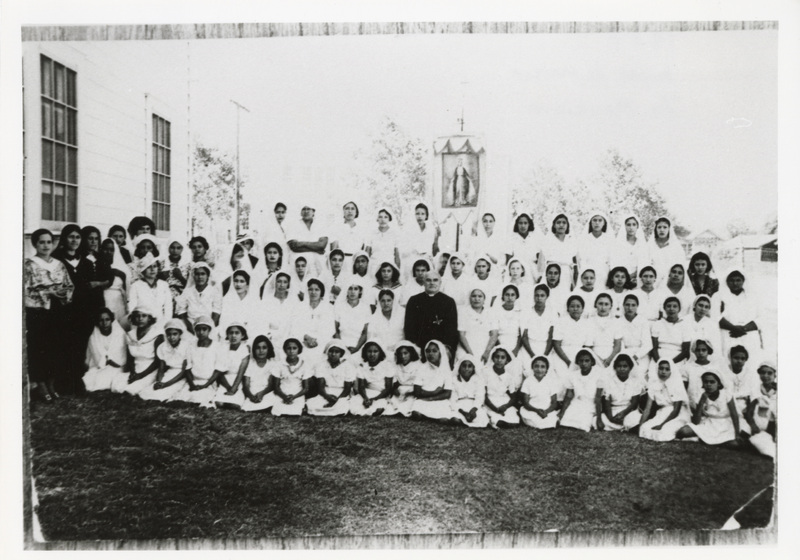
By September 1931, the new pastor from Holland, Fr. Paul J. Potgens, or "El Padre Pablo," was residing in a small room attached to the sacristy that served as an office, living area, and bedroom. Within a month, he supervised the construction of a two-story building while also organizing religious instruction for about 3,000 children in several catechetical centers. These centers included the church and its hall, a pecan shelling establishment, several family homes, a new mission building (St. Augusta), and the Our Lady of the Lake Convent on the outskirts of the parish.
The catechetical ministry was primarily carried out by the Hijas de María (Daughters of Mary), which had been organized early on by the Redemptorist Fathers. They had also promoted other women’s sodalities, such as the Archconfraternity of Our Lady of Perpetual Help and the Society of the Blessed Sacrament. Another group, the Prima Primaria, was established later. The Holy Name Society was organized in 1933, starting with 62 men and adding about twenty new members every year. By 1935, the St. Vincent de Paul Society was helping the poor in the parish, and the St. Alphonsus Child Welfare Center and Clinic had been established. In one year alone, more than 2,800 of the faithful were treated there.
This outreach to the poor was possible because some parishioners at St. Alphonsus enjoyed a degree of economic security. In fact, the pastor of Our Lady of Guadalupe Parish—of which St. Alphonsus had been a mission—once remarked that his parish had lost most of its members who were in better circumstances than the residents around his church.
The new parish experienced dynamic growth. In 1937, there were:
-
59 couples joined in Holy Matrimony
-
421 infants brought into the faith community through Baptism
-
282 youngsters who received the Holy Spirit in Confirmation
-
141 of the faithful brought to the church for their funeral rites
That same year, parishioners involved in catechetical work were organized into the Confraternity of Christian Doctrine. The Divine Providence Sisters and students from Our Lady of the Lake High School and College also participated in this ministry and offered Summer School programs.
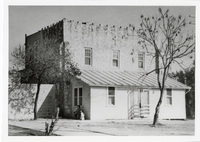
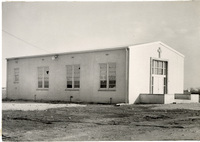
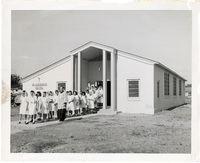
The Missionary Oblates of Mary Immaculate began their ministry at St. Alphonsus in 1935. New properties were acquired, and new buildings were constructed to serve the growing parish during World War II. From its foundation in 1925 to 1948, pastors registered 10,653 Baptisms, 1,360 Marriages, 4,860 Confirmations, and 3,450 funeral services.
From 1940 to 1960, San Antonio's population more than doubled, reaching 590,000. The parish boundaries comprised a sizable section of the growing Westside, with two major military installations nearby. As a result, the St. Alphonsus missions became independent parishes.
-
Our Lady of Good Counsel was organized in 1946.
-
The St. Augusta mission developed into St. Jude's in 1952, the same year San Juan de los Lagos was established.
-
A year later, St. Timothy became a separate parish.
This expansion was made possible with help from the Oblates of Mary Immaculate, the San Antonio Archdiocese, several national Catholic agencies, and the parishioners themselves, who raised funds through making and selling tamales and holding jamaicas (festivals).
On October 12, 1962, the St. Alphonsus community gathered for the blessing of the new clinic dedicated to Our Lady of Guadalupe. This project was once again funded by contributions from the Archdiocese, the Oblates of Mary Immaculate, and the parishioners. The booklet distributed for the occasion listed the various parish organizations and one hundred padrinos (sponsors).
By 1975, St. Alphonsus had adopted some of the Vatican Council reforms. The 50th Anniversary booklet stated: "The parish is governed by an active lay Parish Council...The parish is divided into six geographic areas, each area has a monthly prayer meeting and Bible discussion. There is an energetic religion program and choral group for high school students. The adults of the parish participate actively in weekly Bible study classes...Christian Doctrine is under the direction of Sister Catherine Zamarripa, Missionary Catechist of Divine Providence...all are engaged in active social service, visiting the sick, feeding the hungry and clothing the naked..."
The parish celebrated its 60th anniversary in 1985. A commemorative booklet included photographs of a dozen parish organizations and over a hundred individuals and families. The names of parishioners who regularly volunteered for various ministries—including church maintenance, the choir, home visitation, and the St. Vincent de Paul Society—were also listed.
From the parish's earliest days, a congregation of Mexican sisters, Las Hijas Mínimas de María Imaculada, provided faith formation lessons. Later, Divine Providence Sisters served the community by sponsoring a "Catechetical Center" at Our Lady of the Lake College. At some point, the Sisters of the Holy Spirit took over directing the ministry to children. For many years, the Missionary Catechists of Divine Providence (MCDP) were assigned to the parish, and in recent times, Our Lady of Victory Missionary Sisters have taken up that work.
The ministry to children was always supported by the Archdiocese, which was strongly advocated by Archbishop Robert E. Lucey through the Confraternity of Christian Doctrine. The faith formation sessions were offered to children after school on weekdays and weekends. The Sisters taught some classes and directed volunteer assistants. They also dedicated morning hours to home visitations, an important ministry that encouraged participation in church activities, especially attendance at Sunday Mass and religious education for children. They were also instrumental in assisting many couples in having their marriage blessed in Holy Matrimony.
Youngsters at St. Alphonsus have also been encouraged to join the Catholic Youth Organization (CYO), which coordinated sports events with participating parishes city-wide. These and other activities, such as a 1949 Parish League "Queen Contest," promoted social and cultural interaction among Catholics from different neighborhoods.
In the 25th anniversary (1999) booklet of COPS (Communities Organized for Public Services), St. Alphonsus parishioners claimed they were among the first parishes to join that "power organization." Their unit quickly became known as "La Esperanza del Barrio" (The Hope of the Neighborhood). Their success in pressing for new paved streets with curbs and sidewalks resulted in many new houses in the Colonia San Alfonso. With the closing of the nearby Lutheran General Hospital, they succeeded in having the Bexar County Hospital District acquire and revive that institution. Additionally, the area was chosen for the Texas Diabetes Institute. Parishioners also joined COPS in securing a senior apartment community for the neighborhood and various education and job training projects.
After over 40 years of ministry at St. Alphonsus, the Oblates of Mary Immaculate withdrew in 1979, and the parish experienced some instability. It was served by priests from the Order of the Augustinians and later by diocesan clergy. Additionally, the neighborhood was changing; with some improvement in educational opportunities, many young people moved to new housing developments further west or to the near Northside. All the while, new immigrants who came into the area did not immediately join the parish. Still, some parish societies, like the CYO, remained strong.
A new era dawned in the late 1990s when the Order of the Friars Minor accepted the ministry of the parish. One of the pastors was Friar Arturo Miguel Ocampo y Rivera, whose family had deep roots in the community. Friar Arturo brought the community together by reviving traditional devotions and beginning a campaign to remodel the church and other buildings. The Eucharistic celebration gained new vibrancy with the altar closer to the worshipers and the introduction of new hymns.
The neighborhood's demographic changes have persisted. While maintaining its identity, St. Alphonsus, now under the leadership of the Order of Friars Minor Conventual, became part of a larger Tri-Parish unit, connecting it with the nearby faith communities of Our Lady of Guadalupe and Immaculate Conception. The Friars Minor have continued to serve the parish to the present, providing stability during this period of evolution and growth.
The St. Alphonsus faith community has been an anchor of unity for the neighborhood as San Antonio has undergone many changes over the last hundred years. The parishioners continue to come together for the Eucharist and other religious celebrations, and they contribute to the upkeep of the buildings, which remain a sign that this little corner of San Antonio is still their home and a thriving place for future generations.
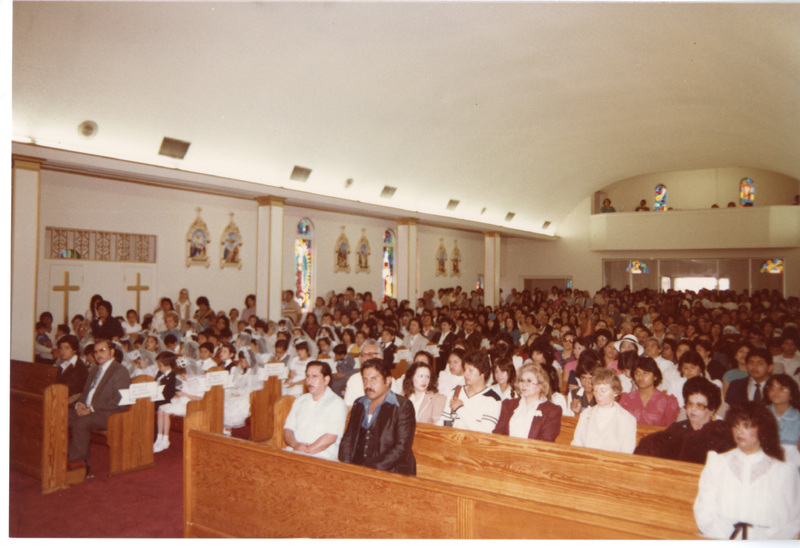
Oblate Archives, various pamphlets and documents, posted in San Antonio and Texas Católico Westside Parish History Project, Center for Catholic Studies, St. Mary’s University.